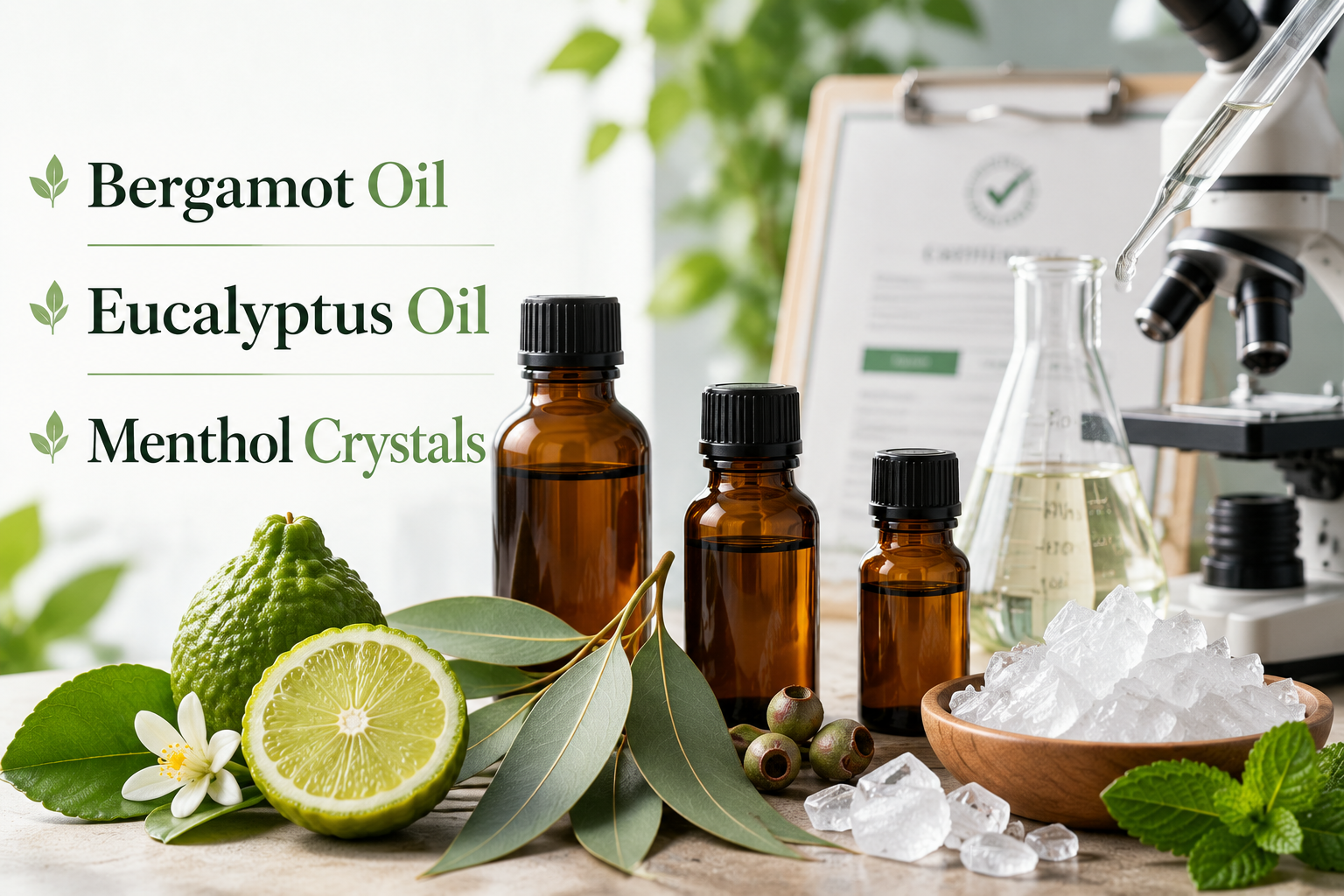
Scroll through any essential oils marketplace and "100% pure" shows up on nearly every listing out there, whether it's bergamot, eucalyptus, or menthol. Far fewer of those manufacturers can actually back that claim up with paperwork.
At Divisha Natural Flavours And Fragrances Exports, we treat purity as something to prove, not just print on a label, which is exactly what this guide is meant to help buyers understand when evaluating suppliers across all three.
Bergamot carries a bright, citrusy top note with a slightly bitter edge, and that exact profile is what makes it valuable in perfumery and skincare. It's also what makes it easy to fake. A cheaper citrus oil, lightly reconstructed with synthetic aroma compounds, can smell close enough to pass a casual sniff test once it's blended into a finished perfume or lotion.
Genuine bergamot oil comes from freshly harvested citrus peels, since peels that sit too long before processing lose the volatile compounds responsible for that recognizable top note. What actually confirms authenticity is the presence of naturally occurring compounds like linalyl acetate and linalool in the right ratios, along with proper screening for bergapten, a compound linked to skin photosensitivity that reputable manufacturers disclose clearly. Buyers evaluating Bergamot Oil Manufacturers should ask for batch-specific lab results, not a single certificate reused across shipments.
Storage matters too, more than people assume. Bergamot oil is sensitive to light, heat, and prolonged air exposure, so oil sitting in poorly sealed containers under warehouse lighting for months can quietly lose quality long before it reaches a buyer's shelf.
Eucalyptus oil shows up in an unusually wide range of products — chest rubs, floor cleaners, respiratory therapies, and aromatherapy blends all rely on it, but for different reasons. What stays constant across all of them is genuine cineole content. Without it, the oil is mostly decorative, no matter how strong the eucalyptus scent seems on first impression.
This is where a lot of buyers get caught off guard. Cheaper eucalyptus oil is sometimes diluted or blended with filler oils to cut costs, and the issue often doesn't surface until customers complain that a product feels weaker than expected. In pharma-adjacent applications, this isn't a minor inconvenience since it can directly affect whether the product does its job at all.
Genuine eucalyptus also depends on which species the oil came from, since globulus, citriodora, and hybrid varieties carry different compound profiles and different intended uses. Anyone sourcing from Eucalyptus Oil Manufacturers should confirm both the species and the cineole percentage through an actual lab report, not just a supplier's word.
Menthol crystals look simple on the surface, just a cooling agent, nothing more. But anyone working in pharma, oral care, or confectionery manufacturing knows that inconsistency between batches can quietly derail an entire production run. Solubility problems, uneven cooling sensation, or crystals that don't dissolve properly in a formulation can force a whole batch to be reworked.
Menthol crystal quality depends heavily on how carefully the distillation process isolates the compound, and cutting corners there doesn't always show up until the product is already mid-production. Genuine menthol should carry a specific, verifiable melting point range and a clean crystalline structure, both of which are easy to test but rarely disclosed upfront by lower-cost suppliers.
Buyers working with Menthol Crystals Manufacturers should ask for consistent batch documentation across multiple orders, not just the first sample sent for evaluation, since that's usually where inconsistency starts to show.
Perfumery and fine fragrance formulations rely on bergamot's citrus-floral complexity as a top note, while eucalyptus adds a sharp, medicinal edge to functional personal care products.
Pharma and respiratory-care formulations depend on eucalyptus for genuine cineole strength and on menthol crystals for reliable cooling and solubility.
Oral care and confectionery manufacturers need menthol crystals with consistent melting points and clean crystalline structure batch after batch.
Aromatherapy blends often combine bergamot's mood-supporting citrus note with eucalyptus's clarifying, respiratory character.
Purity in essential oils was never really about what's printed on the label, it's about what a manufacturer is willing to show when asked. Whether it's bergamot's chemical profile, eucalyptus's cineole strength, or menthol's melting point consistency, the details that actually matter are the ones most suppliers would rather buyers not dig into.
At Divisha Natural Flavours And Fragrances Exports, we'd rather buyers ask those questions upfront than find out the answers the hard way after a bulk order arrives. Documentation, batch testing, and a willingness to answer every question honestly are what separate a supplier worth building a long-term relationship with from one that's just good at writing "100% pure" on a label.