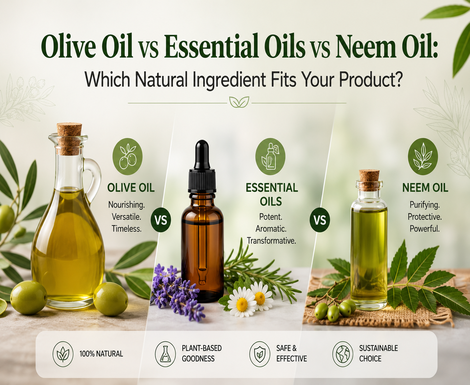
Natural oils aren't just sitting in the "traditional remedies" corner anymore. They've worked their way into skincare, haircare, cosmetics, aromatherapy, wellness, soaps, fragrances, and personal care lines across the board. But with so many botanical ingredients competing for attention, buyers keep landing on the same question: which oil actually fits my product
Olive oil, essential oils, and neem oil don't behave the same way at all. One leans toward moisturizing formulations, another is built for fragrance and sensory impact, and the third tends to appeal to brands chasing a botanical-focused skincare or haircare identity.
Getting a handle on these differences helps manufacturers, formulators, retailers, and new brands make smarter choices — rather than grabbing an ingredient just because it happens to be trending.
Olive Oil Manufacturers supply an ingredient prized for its range across beauty, personal care, wellness, and even food. In cosmetic formulations, olive oil finds its way into creams, lotions, body oils, soaps, haircare products, massage blends, and cleansers.
A big part of its edge is simply that people already know it. Consumers recognize olive oil as a plant-derived ingredient without needing convincing, which makes it that much easier for brands to tell a natural-product story.
It works especially well in formulations that call for a richer oil profile — think body-care products, traditional-inspired skincare, hair oils, and anything leaning into deep moisture.
That said, not all olive oil is created equal. Buyers should look closely at quality, processing, intended application, purity, and storage before locking in a raw material.
Demand for Natural Essential Oils Manufacturers keeps climbing as fragrance, aromatherapy, clean beauty, and wellness markets expand. Unlike carrier oils, essential oils are highly concentrated and aromatic, so they're typically used in much smaller amounts within a formulation.
Their real draw is the sensory experience. Every botanical source brings its own aroma, giving brands the tools to build fragrances and product identities that actually stand out.
You'll find essential oils in perfumes, soaps, candles, aromatherapy blends, personal care products, massage blends, and select cosmetics. For a brand chasing a memorable scent profile, the right essential oil can end up being one of the most important pieces of the whole product.
They do demand careful handling, though. Concentration levels, intended use, compatibility with other ingredients, and safe usage thresholds all need attention. That's exactly why sourcing quality matters so much when working with these concentrated botanicals.
Neem Oil Manufacturers supply an ingredient that's seeing renewed interest as consumers rediscover traditional botanicals. Neem oil regularly shows up in soaps, haircare products, skincare formulations, body-care lines, and other botanical personal care applications.
Its strongest pull is the connection to traditional plant-based practices. Brands building herbal, botanical, or naturally inspired concepts can lean on neem oil as part of a formulation that bridges old-world ingredients with modern product development.
Neem also has a distinctive character of its own, so formulators need to think through its aroma and how well it plays with other ingredients. It tends to shine when it's paired thoughtfully alongside complementary components.
For businesses, that's really the appeal — not that neem oil fits everywhere, but that it can help carve out a genuinely differentiated botanical product line.
Truthfully, there's no single "best" natural oil that works for every application. The right pick comes down to what the finished product is meant to do.
For rich personal care and body formulations, olive oil is often the practical call, thanks to its versatility and familiar botanical identity.
For fragrance-driven, sensory-first products, essential oils bring distinctive aromatic profiles and help brands create an experience people actually remember.
For herbal and traditional-inspired formulations, neem oil can offer a compelling botanical angle.
So really, the decision should start with the product, not the ingredient. Figure out what the finished product needs to achieve first, then work backward to the oil that fits.
Consumers are getting pickier by the day. They want products that look and feel natural, sure, but they're also expecting quality, consistency, transparency, and a genuinely good experience alongside it.
Clean beauty is still a major force, and botanical skincare, aromatherapy, herbal haircare, sustainable sourcing, and multi-use personal care products all continue to draw interest. More buyers are researching ingredients before they ever click "buy," which means ingredient education has become a real part of modern marketing — not an afterthought.
That's exactly why brands need to steer clear of inflated claims just because something is "natural." Accurate product information, responsible formulation, quality sourcing, and honest communication go a lot further.
Even the best-suited oil can't deliver consistent results if quality swings from batch to batch. That's why businesses need to evaluate suppliers on quality management, sourcing, processing, packaging, documentation, consistency, and reliability of supply.
A supplier you can actually count on helps manufacturers hold their formulation standards steady and cuts down on production headaches — something that matters even more once a business scales from small batches to full commercial volumes.
Divisha Natural Flavours And Fragrances Exports supplies natural oils and aromatic ingredients to businesses across cosmetics, personal care, fragrance, wellness, and related industries, with a strong focus on quality and dependable supply.
The future of natural products isn't about picking one ingredient and using it everywhere. It's about understanding what each ingredient actually brings to the table and building formulations around real consumer needs.
Olive oil supports versatile personal care concepts, essential oils bring in distinctive aromatic experiences, and neem oil strengthens botanical positioning. Each one has its own lane in the modern natural-products space.
For buyers and manufacturers, the smartest move is comparing ingredients by application, quality, formulation requirements, consumer expectations, and product positioning. Match the right ingredient with the right product, and natural oils stop being just raw materials — they become part of a brand's identity and market appeal.
Natural ingredients are having a moment, but building a successful product takes more than riding a trend. Buyers need to understand the characteristics, applications, and limits of each oil before committing to a purchase.
Whether you're building skincare, haircare, aromatherapy, fragrance, wellness, or personal care products, picking the right natural ingredient shapes both formulation quality and how customers perceive the finished product. A purpose-driven approach, backed by reliable sourcing and careful formulation, gives businesses a much stronger foundation for making products that today's consumers genuinely want.